When sourcing silicone baking mats wholesale, international procurement officers, commercial bakery distributors, and private-label kitchenware brands must recognize that product compliance is far more than a legal bureaucratic checkmark. It operates as a critical supply chain risk-mitigation safeguard designed to protect your corporate investment against catastrophic product recalls, customs border seizures, and long-term brand degradation. When ordering commercial baking liners at scale from global manufacturers, a granular, engineering-level understanding of the technical, chemical, and regulatory differentiation between FDA (Food and Drug Administration) and LFGB (Lebensmittel-, Bedarfsgegenstände- und Futtermittelgesetzbuch) frameworks is paramount to maintaining a secure and reliable supply network.
1. The Chemical Threshold: Peroxide vs. Platinum Curing Systems
The structural and chemical variance between standard consumer-grade mats and premium industrial-grade alternatives begins long before third-party laboratory testing takes place—it is determined during the initial vulcanization and polymer curing phases of raw manufacturing.
- Standard Retail Formulations: A significant percentage of budget-driven suppliers utilize standard peroxide curing catalysts to bind the silicone polymer chain. While highly cost-effective for high-volume mass production, this specific chemical process naturally leaves behind volatile trace residues, acidic cross-linking byproducts, and a distinct, sharp polymer odor if manufacturing cycle times are compressed to save factory overheads. Under rigorous laboratory extraction tests, these unreacted siloxane residues frequently migrate into food simulants, failing strict international safety thresholds.
- Our Premium Engineering Capabilities: To guarantee flawless compliance with the world’s strictest food-contact regulations, our bulk manufacturing workflows are highly adaptive. For high-end private labels, commercial baking franchises, and strict Western market entry protocols, we supply premium platinum-catalyzed liquid silicone rubber (LSR) systems. Platinum curing involves an addition-cure reaction that leaves absolutely zero toxic byproducts or organic acids in the elastomeric matrix. This advanced material configuration delivers vastly superior tensile strength, remarkable dimensional stability under continuous thermal stress, and an exceptionally low level of initial volatile organic compounds.
2. Regulatory Differentiation: FDA 21 CFR 177.2600 vs. German LFGB
While both regulatory frameworks certify that a silicone elastomer is fundamentally safe for contact with food, their respective laboratory testing protocols, chemical migration thresholds, and verification methodologies differ drastically:
| Testing Parameter | FDA 21 CFR 177.2600 (US Standard) | LFGB / BfR XV (European Standard) |
|---|---|---|
| Primary Methodology | Measures overall extractives via distilled water and n-hexane reflux. | Measures total Volatile Organic Matter (VOM) and specific sensory migration. |
| Volatile Organic Matter (VOM) Limit | Not strictly quantified via baking weight-loss tests. | Strictly limited to less than 0.5% weight-loss after intensive thermal testing. |
| Sensory Neutrality (Odor & Taste) | Optional or based on basic qualitative evaluation. | Mandatory. Must pass a rigorous human panel test to ensure zero transfer of off-flavors to food. |
Because European LFGB testing targets volatile organic compounds at a micro-level, a baking liner that easily passes standard American FDA criteria might still completely fail European compliance if the manufacturing facility bypassed essential vulcanization control phases. For instance, the German BfR XV standard considers any transfer of odor or taste to the food simulant as an immediate failure, requiring highly controlled material synthesis.
3. A Buyer’s Guide to Verifying Lab Reports (Avoiding Compliance Traps)
When sourcing bulk shipments, many B2B buyers fall into the trap of accepting a generic “FDA Pass” certificate without reviewing the actual laboratory test data. To ensure your shipment is fully compliant, procurement managers should look for three specific metrics on third-party reports (such as SGS, TUV, or Intertek):
- Check the Specific Clause: For silicone, the report must explicitly state compliance with FDA 21 CFR 177.2600 or German BfR Recommendation XV for LFGB. General rubber tests are invalid for food-grade kitchenware.
- Verify the Migration Values: For LFGB, locate the Volatile Organic Matter (VOM) section. Ensure the reported numerical value is comfortably below the 0.5% weight-by-weight limit (e.g., 0.2% or 0.3%). A narrow margin or a simple “Pass” label without raw data warrants a secondary audit.
- Cross-Reference the Manufacturing Batch: Ensure the material composition listed on the lab report matches the exact specification sheet of your wholesale purchase order, particularly regarding colorants and thickness dimensions.
4. Mitigating VOM to Deliver Premium Silicone Baking Mats Wholesale
To guarantee that our global volume shipments consistently pass their target testing criteria without exception, our engineering team enforces a strict, non-negotiable Post-Curing Protocol at 200°C (392°F) in secondary automated convection ovens.
This advanced manufacturing step forces the complete evaporation and extraction of any remaining low-molecular-weight siloxanes and Volatile Organic Matter (VOM) from the structural silicone-fiberglass matrix.
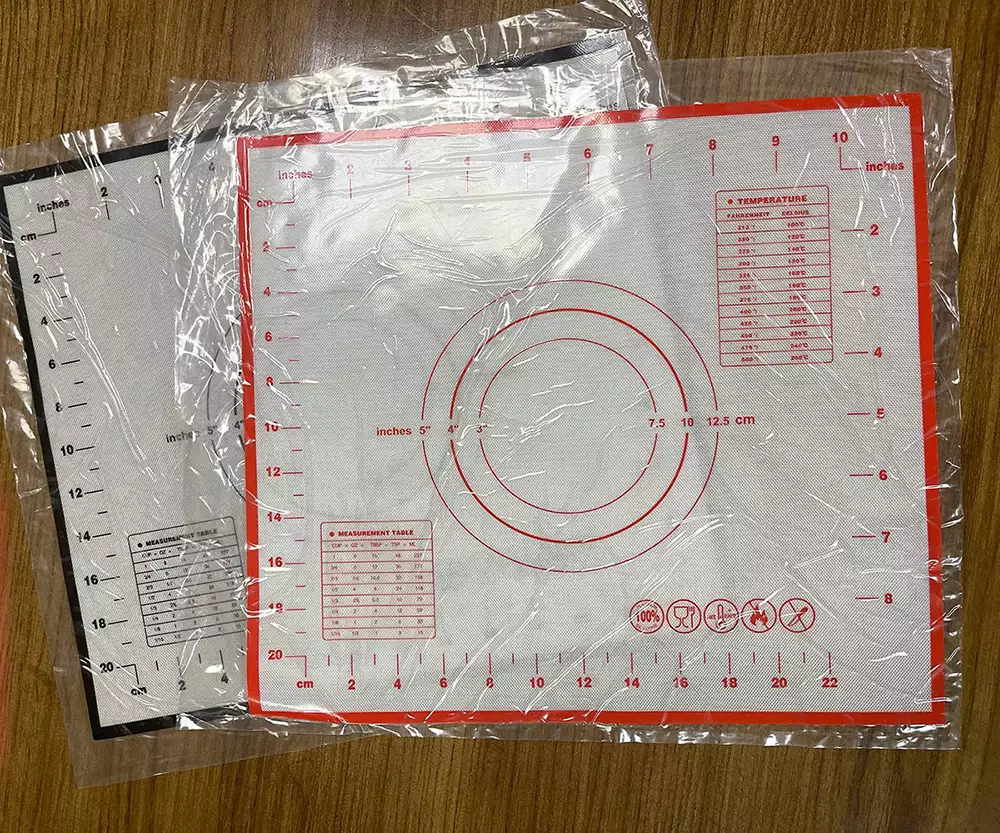
As a trusted global manufacturing partner, we regularly utilize this protocol to engineer premium [silicone baking mats wholesale] customized to meet these rigorous international regulations. The resulting product is completely odorless, chemically inert, and fully optimized to withstand thousands of continuous commercial baking cycles without releasing hazardous emissions, warping under intense thermal shock, or impacting the pristine sensory neutrality of delicate pastry doughs.