Introduction
If you are sourcing non-stick kitchenware, you have likely encountered two main coating technologies: PTFE (polytetrafluoroethylene) and ceramic. Both are marketed as non-stick solutions, but they work differently, perform differently, and suit different applications.
This guide compares PTFE vs ceramic coating across five key dimensions: non-stick performance, durability, heat resistance, safety, and cost.
As a B2B buyer — whether you are a brand, retailer, wholesaler, or importer — understanding the difference helps you make better sourcing decisions for your product line.
This guide compares PTFE and ceramic coatings across five key dimensions: non-stick performance, durability, heat resistance, safety, and cost.
What Is PTFE Coating?
PTFE is a synthetic fluoropolymer. It has been the industry standard for non-stick cookware and kitchenware for decades.
Its non-stick properties come from an ultra-low surface energy: water, oil, and food simply do not adhere to it easily. PTFE also has a very low coefficient of friction, making it extremely slippery.
Key characteristics of PTFE coatings:
- Excellent non-stick performance: Food releases easily, even sticky substances like dough and batter
- Chemical inertness: Resists nearly all acids, bases, and solvents
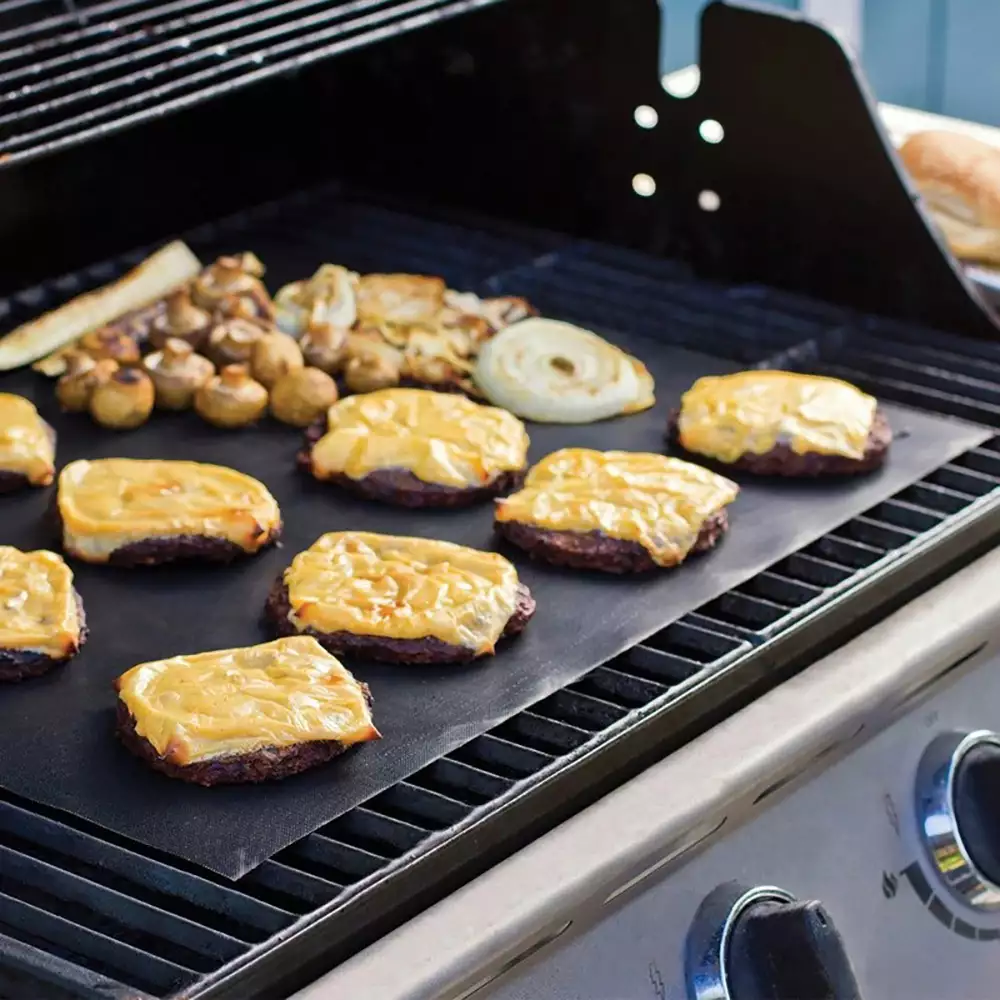
- Flexibility: Can be applied to flexible substrates like fiberglass fabric (this is how PTFE grill mats are made)
- Operating temperature: Stable up to 260°C (500°F); begins to degrade above this threshold
PTFE coatings are PFOA-free today. The concern about PFOA — a processing aid used in the past — has been addressed. Major manufacturers phased out PFOA globally over a decade ago.
What Is Ceramic Coating?
Ceramic non-stick coatings are made from inorganic materials, typically silicon-based compounds like silicon dioxide (silica) or silicon carbide, applied through a sol-gel process. They are marketed as a “green” or “PFAS-free” alternative to PTFE.
Key characteristics of ceramic coatings:
- Non-stick performance: Moderate; food releases reasonably well, but not as consistently as PTFE
- Hardness: Very hard and scratch-resistant, but brittle — can crack under bending or impact
- Heat resistance: Withstands temperatures above 500°C — significantly higher than PTFE
- Application: Applied to rigid metal substrates like aluminum pans or baking trays
- Cost: Generally higher due to energy-intensive production (800°C+ sintering)
PTFE vs Ceramic: Key Differences at a Glance
| Factor | PTFE Coating | Ceramic Coating |
|---|---|---|
| Non-stick performance | Excellent, even with sticky foods | Moderate; less consistent over time |
| Durability | Flexible; resists cracking | Hard but brittle; can crack |
| Heat resistance | Up to 260°C (500°F) | Withstands 500°C+ |
| Chemical resistance | Inert to almost all substances | Vulnerable to strong alkalis |
| PFOA/PFAS | Modern PTFE is PFOA-free | Marketed as PFAS-free |
| Substrate | Can coat flexible materials (fabric) | Requires rigid metal substrate |
| Application cost | Lower curing temps (200-400°C) | Higher energy cost (800°C+) |
| Lifespan | Longer; consistent performance | Shorter; performance declines with use |
Durability: What the Science Says
Scientific studies have measured the performance of both coating types. Here is what the data shows:
PTFE outperforms ceramic in long-term non-stick durability.
A study published in 2025 tested five ceramic coatings against PTFE under repeated cooking cycles. The results showed that PTFE maintained low and consistent food-release performance after 90 cooking cycles, with an average release force up to three times lower than the best-performing ceramic coating.
PTFE also outperformed ceramics in resisting severe wear. Ceramic coatings showed competitive performance initially, but their non-stick properties declined more quickly with use.
In practical terms: PTFE coatings keep their non-stick performance longer. Ceramic coatings may start well but degrade faster, especially under high-heat or abrasive conditions.
Substrate and Application: A Critical Difference
This is where the two technologies diverge most significantly from a product development perspective.
PTFE coatings can be applied to flexible substrates — such as fiberglass fabric. This is why PTFE grill mats exist. The material can bend, fold, and conform to different surfaces while maintaining its non-stick properties.
Ceramic coatings require rigid substrates — typically aluminum or stainless steel pans, trays, or molds. They cannot be applied to flexible materials because the ceramic matrix is brittle and would crack under bending.
What this means for your product line:
| Product Type | PTFE Coating | Ceramic Coating |
|---|---|---|
| Flexible grill mats | ✅ Suitable | ❌ Not suitable |
| Rigid baking pans | ✅ Suitable | ✅ Suitable |
| Conveyor belts | ✅ Suitable | ❌ Not suitable |
| Frying pans | ✅ Suitable | ✅ Suitable |
| Molds and trays | ✅ Suitable | ✅ Suitable (rigid only) |
Safety: Both Are Safe When Used Correctly
PTFE: Modern PTFE coatings are PFOA-free and approved for food contact by the FDA, EFSA, and German BfR. The material is chemically inert — even if small particles are ingested, they pass through the body unchanged. The only safety consideration is avoiding overheating above 260°C (500°F), which can cause degradation and fume release.
Ceramic coatings: Marketed as PFAS-free, which appeals to consumers concerned about environmental and health impacts. They are also safe for food contact. However, some ceramic coatings contain materials (such as chromium compounds) that raise separate considerations.
From a safety perspective, both coatings are acceptable for food-contact applications when used as intended.
Which One Should You Choose?
The decision depends on your product line and target market.
Choose PTFE coating if you need:
- Flexibility: Your product requires a flexible substrate (e.g., grill mats)
- Long-lasting non-stick performance: Your customers expect consistent release over many uses
- Cost-effectiveness: Lower production costs and higher durability per unit
- Proven technology: An established industry standard with decades of performance data
Choose ceramic coating if you need:
- Extreme heat resistance: Applications exceeding 260°C
- PFAS-free marketing: A clear “no PFAS” message for environmentally conscious consumers
- Hardness and scratch resistance: Products that face abrasive use
- Rigid substrates: Your product is metal-based and doesn’t require flexibility
For most kitchenware applications — especially grilling, baking, and food preparation — PTFE remains the proven, cost-effective standard.
Conclusion
PTFE and ceramic coatings both offer non-stick solutions, but they serve different applications and market positions.
| Aspect | PTFE Coating | Ceramic Coating |
|---|---|---|
| Non-stick performance | ⭐⭐⭐⭐⭐ | ⭐⭐⭐ |
| Durability over time | ⭐⭐⭐⭐⭐ | ⭐⭐⭐ |
| Heat resistance | ⭐⭐⭐⭐ (260°C) | ⭐⭐⭐⭐⭐ (500°C+) |
| Flexibility | ⭐⭐⭐⭐⭐ | ⭐ |
| Cost-efficiency | ⭐⭐⭐⭐⭐ | ⭐⭐⭐ |
| PFAS-free messaging | ⭐⭐⭐⭐ | ⭐⭐⭐⭐⭐ |
PTFE remains the preferred choice for manufacturers and brands that value consistent non-stick performance, durability, and flexibility — especially for products like grill mats, baking liners, and commercial kitchen equipment.
If your product line demands flexible, durable, and cost-effective non-stick solutions, PTFE coating is your proven partner.
We manufacture PTFE grill mats and PTFE-coated baking liners with FDA and LFGB certification, PFOA-free, and customizable options for brands, retailers, and wholesalers. Contact our team to discuss your product requirements.
📧 Email: sales@ptfegrillmaster.com
📞 WhatsApp: +86 17758008874